“I can think again.” “My head finally feels clear.” “I can find my words.” “I don’t feel like I’m walking around in a cloud anymore.” Among the many experiences people have associated with chlorine dioxide, improved mental clarity can be one of the more intriguing.
Herb Roi Richards has heard enough of these reports over the years that brain fog has become one of the recurring observations in his field experience with chlorine dioxide. But there’s something unusual about brain fog.
Brain fog isn’t really one thing.
It isn’t a single disease with one known cause and one standard treatment. Clinically, the term describes a collection of cognitive symptoms: difficulty concentrating, forgetfulness, losing one’s train of thought, slower thinking, mental exhaustion, and difficulty finding words.
So when someone says: “Chlorine dioxide got rid of my brain fog.” there’s another question hiding inside that statement.
What caused the fog in the first place? And that may be considerably more interesting.
Same Fog. Different Weather
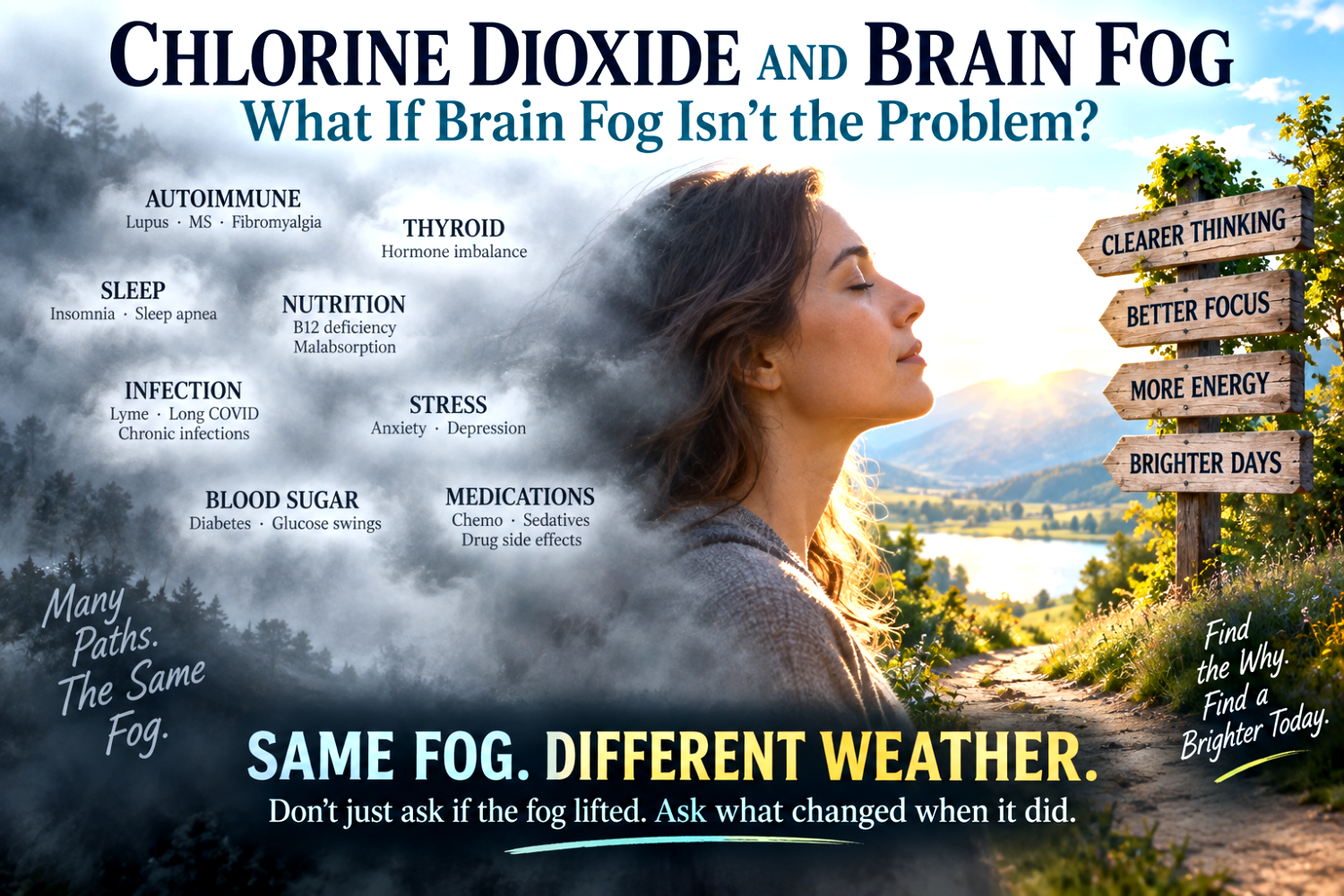
Imagine ten people sitting in a room. Every one of them complains of essentially the same thing: “My brain just isn’t working right.”
One has an autoimmune condition. Another has hypothyroidism. Another hasn’t slept properly in months. Someone else has long COVID. Another is experiencing depression or anxiety. One has blood-sugar problems. Another has nutritional problems. Someone is taking medication that affects cognitive function. And another hasn’t yet discovered what’s wrong.
Their descriptions may sound remarkably similar. Yet what’s happening underneath may be very different.
That’s one of the fascinating things researchers are discovering about brain fog. A recent transdiagnostic review found the term appearing across a surprisingly broad collection of conditions, including long COVID, menopause, hypothyroidism, traumatic brain injury, ME/CFS, fibromyalgia, and lupus. Researchers are now asking whether similarities across these different conditions might reveal common mechanisms.
In other words: Same fog. Different weather.
Brain Fog Is More Like a Dashboard Light
Maybe another way to think about brain fog is the warning light on your car. The light tells you: Something needs attention. But it doesn’t necessarily tell you what.
The problem could be minor. It could be serious. It could originate in several completely different systems.
Nobody repairs a car by replacing the check-engine light. They investigate what caused it to illuminate.
Brain fog can present us with a similar challenge.
The symptom is happening in our thinking, but that doesn’t necessarily mean the original problem began in the brain.
Sometimes the Problem Really Is Somewhere Else
Consider hypothyroidism. An underactive thyroid can produce forgetfulness and difficulty concentrating—the very symptoms people commonly call brain fog.
Or consider diabetes and hypoglycemia. Blood-sugar disturbances can leave someone feeling foggy and unable to concentrate.
Poor sleep can do it. Anxiety and depression can do it. Autoimmune conditions including lupus, multiple sclerosis and fibromyalgia are associated with it. Nutritional problems can contribute. Certain medications can affect cognitive function. Chemotherapy can produce the familiar phenomenon sometimes called “chemo brain.” Long COVID has made brain fog particularly familiar to millions of people. Even celiac disease has been associated with brain-fog-like cognitive complaints.
That’s an extraordinary variety of circumstances producing something people describe with essentially the same two words: Brain fog.
The Fog Doesn’t Tell Us Where the Weather Came From
This is where the subject becomes especially interesting. Suppose someone has brain fog associated with poor sleep. Helping that person’s sleep might improve their mental clarity without doing anything directly to their brain.
Suppose another person’s fog accompanies hypothyroidism. Correcting the thyroid problem may improve cognition.
Someone experiencing hypoglycemia may become mentally clearer when glucose normalizes.
Someone whose medication is contributing to cognitive slowing may improve when a clinician appropriately changes that medication.
The symptom changed because something upstream changed.
That doesn’t make the symptom unreal. Quite the opposite. It helps explain it.
And this is where the reports surrounding chlorine dioxide become worth asking better questions about.

Enter Chlorine Dioxide
There is currently no good clinical evidence demonstrating that chlorine dioxide is a treatment for brain fog. That’s important to establish immediately. Chlorine dioxide is an oxidizing disinfectant with established applications, including water treatment, and health authorities warn against drinking chlorine dioxide products marketed as disease treatments.
So reports of clearer thinking following chlorine dioxide use should not be converted into: “Chlorine dioxide treats brain fog.” But they don’t have to be discarded either.
They can become observations. And observations generate questions.
If someone genuinely experiences a substantial improvement in cognitive function after beginning something new, we can ask: What changed?
Maybe We’ve Been Looking at the Wrong End of the Story
The obvious picture would be: Chlorine dioxide → brain → fog disappears. But perhaps that’s too simplistic.
If the reports eventually prove reproducible in some people, there are numerous possibilities worth investigating.
- Maybe something changed involving an underlying illness.
- Maybe gastrointestinal function changed.
- Maybe sleep improved.
- Maybe fatigue improved.
- Maybe inflammatory activity changed.
- Maybe nutritional status changed.
- Maybe something involving the person’s microbial environment changed.
- Maybe another treatment or lifestyle change was responsible.
- Maybe symptoms were already fluctuating.
- Maybe expectation played some role.
Or perhaps something occurred that we haven’t considered yet. We don’t know.
And that’s precisely why the reports become more interesting when we resist the temptation to explain them too quickly.
The Gut Appears—but It Doesn’t Have to Take Over
After our recent scientific explorations of gut–brain and gut–bone connections, it’s easy to make everything about the microbiome. We shouldn’t. But we shouldn’t ignore it either.
The gastrointestinal system can influence nutrition, immune signaling, and metabolism, all of which can influence how someone feels and functions. Researchers are also investigating relationships among the microbiome, inflammation and cognition in several illnesses.
That means the gut is one possible upstream neighborhood. It isn’t automatically the explanation. The same applies to inflammation.
Inflammation may contribute to cognitive symptoms in some conditions, but saying “inflammation causes brain fog” as though every case has the same mechanism would simply replace one oversimplification with another.
Our ten people in the room may still have ten different stories.
Brain Fog May Actually Be Several Different Fogs
This might explain something else people frequently notice.
Not everyone means the same thing when they say brain fog.
- One person means: “I can’t remember anything.”
- Another means: “I can’t concentrate.”
- Someone else says: “I know the word I want, but I can’t retrieve it.”
- Another: “Everything takes me twice as long to think through.”
- Another: “I’m mentally exhausted by noon.”
- And another: “I feel detached and cloudy.”
Those aren’t necessarily identical cognitive problems.
Research reviews have struggled with exactly this issue. Brain fog lacks a single standardized definition, and subjective complaints don’t always line up neatly with objective cognitive testing.
That makes simply asking: “Did your brain fog improve?” a pretty crude research instrument.
We can do better.
What Exactly Got Better?
Suppose someone tells Herb: “My brain fog is gone.” Great.
Now the investigation begins.
- What couldn’t you do before?
- Could you read a page and remember it?
- Could you follow a conversation?
- Could you work for an hour without losing concentration?
- Were you forgetting appointments?
- Could you remember people’s names?
- Were you searching for ordinary words?
- Were you getting lost while performing familiar tasks?
- How long had this been happening?
And after the reported improvement: What can you do now that you couldn’t do before?
Suddenly a vague testimonial begins turning into usable information.
Then Ask the Question Almost Nobody Asks
What else got better at the same time?
This may be the most revealing question in the entire investigation.
- Did sleep improve?
- Did digestive problems change?
- Did pain decline?
- Did fatigue improve?
- Did headaches change?
- Did bowel habits change?
- Did appetite change?
- Did an infection resolve?
- Did anxiety improve?
- Did energy return?
- Did the person’s medications change?
- Did diet change?
- Did glucose control improve?
- Did anything else happen immediately before the fog lifted?
Now we’re looking for clusters. And clusters can reveal patterns.
Imagine 100 Reports Instead of One
One testimonial doesn’t tell us very much. But imagine carefully documenting 100 people who say their brain fog substantially improved while using chlorine dioxide.
Instead of simply recording: Brain fog improved: YES we collect a little more information.
- What was the underlying diagnosis?
- What medications were being taken?
- How was the person’s sleep?
- Did they have digestive problems?
- Was there a known nutritional deficiency?
- Was there an autoimmune condition?
- Was there a recent infection?
- Was this long COVID?
- Was there diabetes or unstable blood sugar?
- How severe was the cognitive problem beforehand?
- How quickly did it change?
- How long did the improvement last?
- What else changed?
And importantly:
- Can we objectively demonstrate that cognition improved?
Now we’re getting somewhere.

We Don’t Even Need Exotic Testing
This is another reason brain fog could make an interesting research subject. Researchers don’t necessarily have to begin with million-dollar laboratories.
Simple cognitive assessments can measure things such as attention, working memory, processing speed and concentration. Long-COVID clinical guidance, for example, discusses neuropsychological tools such as digit-span and vigilance testing and recommends evaluating sleep, medications, endocrine abnormalities, autoimmune conditions, and psychiatric factors when persistent cognitive complaints are present.
That means we could compare: What the person feels with what the person can actually do.
If both improve together, the observation becomes considerably more interesting.
And If Nothing Changes on the Test?
That’s useful information too.
Perhaps the person’s processing speed didn’t change. But fatigue dramatically improved.
Maybe the experience they called “brain fog” was primarily mental exhaustion. Or perhaps sleep improved enough that concentrating simply became easier.
That’s not failure. That’s discovery. We’re beginning to identify which fog we’re actually studying.
The Underlying Condition Matters
This may ultimately prove to be the most revealing part. Imagine that reports of improvement are scattered randomly across every possible cause of brain fog. That’s one result.
But imagine something different.
Suppose most of the strongest reports came from people whose brain fog followed:
- Gastrointestinal illness.
- Or infection.
- Or a particular autoimmune condition.
- Or long COVID.
- Or severe sleep disruption.
- Or nutritional malabsorption.
That pattern would immediately give researchers somewhere to look.
Conversely, perhaps no such pattern appears. That’s useful too.
The point isn’t to make the observations prove something. The point is to let the observations tell us where the next question should go.
What If the Brain Was Never the Primary Target?
This brings us back to our dashboard light. If someone’s mental clarity improves after their thyroid disorder is appropriately treated, we don’t normally say: “The treatment cured brain fog.”
We say the underlying condition improved and cognitive symptoms improved along with it.
Perhaps some chlorine-dioxide reports deserve to be investigated through the same lens.
Not: “How does chlorine dioxide clear brain fog?” but: “What changed when the fog cleared?”
Those questions sound similar. They aren’t. The second one doesn’t assume the mechanism before we’ve discovered it.
Same Fog. Different Weather
Maybe one person’s fog came
- from poor sleep.
- Another’s from endocrine dysfunction.
- Another’s from an autoimmune illness.
- Another’s from medication.
- Another’s from nutritional problems.
- Another’s followed an infection.
- Another’s may involve several things simultaneously.
And perhaps some people reporting improvement after chlorine dioxide will eventually prove to have something in common. Or perhaps they won’t. That’s the mystery.
But there’s something wonderfully useful about brain fog precisely because it isn’t one disease.
It forces us to stop thinking only in diagnostic labels. It makes us ask what else is happening inside the person.
When the Fog Lifts, Look Around
If someone says: “I can think again,” that’s worth listening to.
It isn’t proof that chlorine dioxide caused the improvement. It isn’t proof that chlorine dioxide treated an underlying disease. And it certainly isn’t enough to establish chlorine dioxide as a treatment for cognitive impairment.
But it’s an observation. So write it down.
Ask what “brain fog” meant to that person. Find out what condition they had. Measure what can be measured. Look at what else changed.
Follow them over time. Compare their experience with others. And see whether a pattern emerges.
Because brain fog tells us something important: what the person is experiencing. It doesn’t necessarily tell us: why.
And perhaps that’s what makes these reports so interesting.
Instead of asking: “What did chlorine dioxide do to the brain?” maybe the better question is: “What else changed when the fog disappeared?”
Sometimes the place where a symptom appears isn’t where its story began.
Selected Reading
For readers interested in exploring the subject further, the Cleveland Clinic overview of brain fog provides a useful introduction to symptoms and associated conditions. A recent transdiagnostic scientific review of brain fog examines similarities across otherwise very different diagnoses, while clinical guidance addressing persistent cognitive symptoms after COVID-19 illustrates why clinicians investigate sleep, medications, endocrine disorders, autoimmune disease, infection and mental-health conditions rather than treating “brain fog” as a single disease.
Informational Notice
This article examines questions raised by anecdotal reports and is intended for education and research discussion. There is currently no established clinical evidence that chlorine dioxide treats brain fog, cognitive impairment or the underlying conditions discussed here. Persistent, worsening or sudden cognitive changes deserve medical evaluation because some underlying causes are treatable and others may require prompt attention.