When we think about the things that make us sick, we usually think about bacteria, viruses, parasites, and other tiny living things. We wash our hands, disinfect our homes, and do our best to protect ourselves from these unwanted visitors. But what if the thing making you sick isn’t even alive?
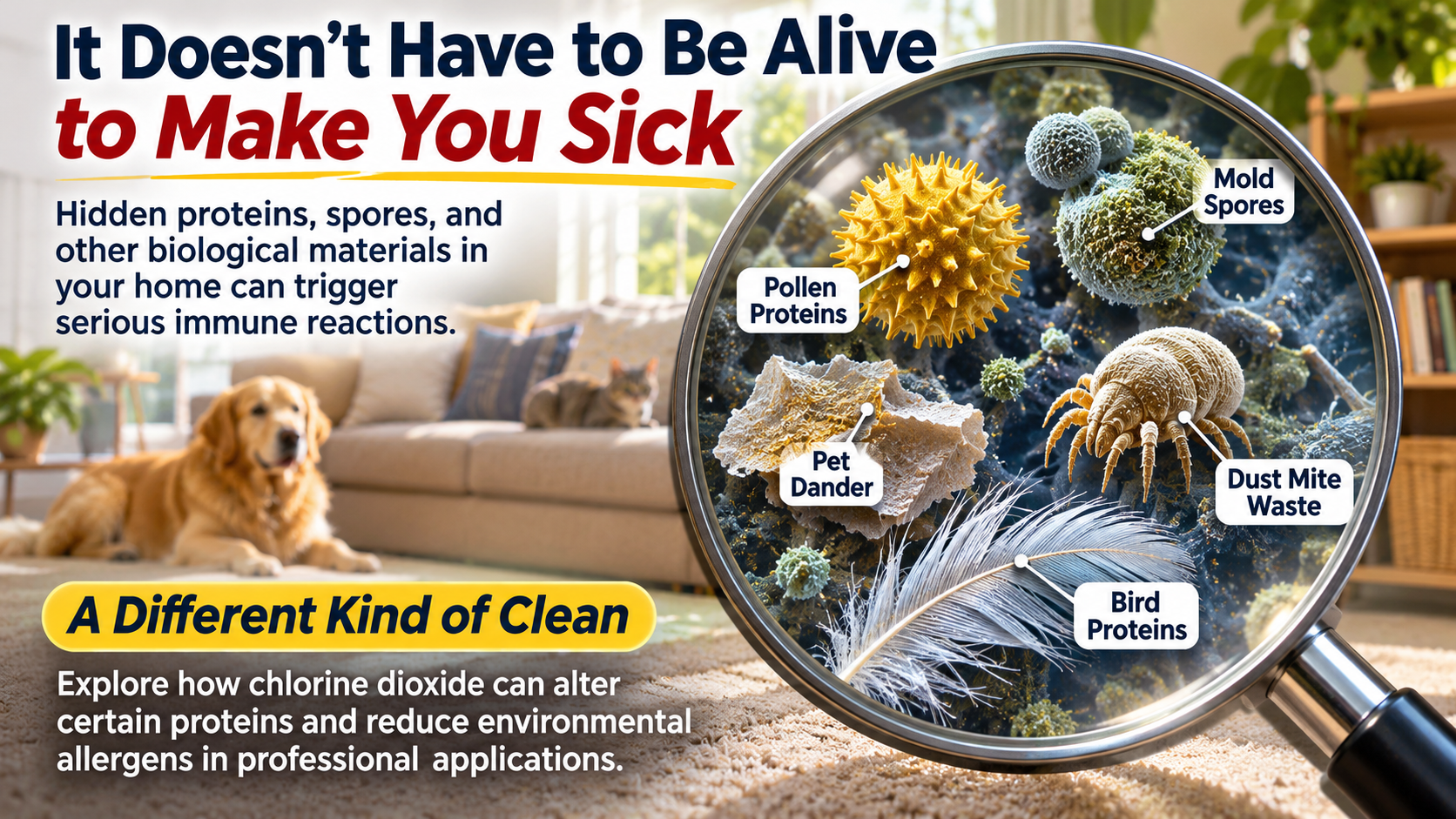
What if it is a tiny piece of protein hiding in your carpet, furniture, clothing, or bedding? It cannot grow, reproduce, or infect you, yet your body may react to it in ways that can make your life miserable.
This is an often overlooked part of environmental health, and it introduces another interesting property of chlorine dioxide that deserves some attention.
The Invisible Things We Live With
Over the years, our homes collect much more than ordinary dust. They also collect tiny pieces of biological material from the people, animals, plants, and microorganisms that have occupied the space.
These may include:
- Pet dander and saliva proteins
- Proteins from bird feathers and droppings
- Dust mite waste
- Pollen
- Mold spores
- Fragments of dead mold
- Remains of bacteria and other microorganisms
Some of these materials can remain in our homes long after their original source has been removed.
You could move into a home where a cat lived years before you arrived and still be exposed to some of the proteins that the cat left behind.
You might never see the cat, but your immune system may know it was there.
When Your Body Sounds the Alarm
Your immune system is designed to protect you. It is constantly looking for things that it believes do not belong inside your body. Sometimes, however, it reacts strongly to substances that are not infectious.
A tiny protein from a pet, plant, or other environmental source can trigger an immune response. These substances are often called antigens. Those that trigger allergic reactions are called allergens.
Depending on the person and the type of exposure, reactions may include sneezing, coughing, watery eyes, skin irritation, breathing difficulties, or inflammation.
In some cases, repeated exposure can contribute to serious lung disease.
One such condition is called hypersensitivity pneumonitis. This condition can develop when a person’s immune system reacts to certain substances that are repeatedly breathed into the lungs. Bird proteins and some types of mold are known triggers.
Over time, continued exposure can lead to permanent scarring of the lungs.
There may be no infection to fight. The problem is the body’s reaction to something in the environment.
Killing Something That Is Already Dead
We often measure the effectiveness of a cleaning product by how many germs it can kill. But how do you kill something that is already dead?
Imagine killing every dust mite in your bedroom. That sounds like a successful treatment, doesn’t it?
Unfortunately, the waste and body fragments left behind by those dust mites may still contain proteins that trigger allergic reactions.
The same can be true of mold. Even dead mold can contain substances that cause unwanted reactions in sensitive individuals.
Disinfection, while valuable, is not necessarily the same as removing or neutralizing an allergen.
This brings us to an interesting property of chlorine dioxide.
Changing the Protein
Chlorine dioxide is well known for its ability to inactivate bacteria and viruses. It has been used in municipal water treatment, food processing, industrial sanitation, and other professional applications.
One of the ways chlorine dioxide works is by reacting with certain parts of proteins.
Proteins are made up of smaller building blocks called amino acids. These building blocks form chains that fold into specific shapes. The shape of a protein helps determine what it does and how other parts of the body recognize it.
Think about what happens when you cook an egg. The clear, slippery egg white turns white and firm. You have changed the structure of its proteins through heat. Scientists call this process protein denaturation.
Chlorine dioxide can also alter proteins, but it does so through a chemical process called oxidation rather than through heat.
Research published in the scientific journal Biochemistry in 2007 demonstrated that chlorine dioxide could modify certain amino acids, particularly tryptophan and tyrosine, resulting in changes to protein structure and function.
This raises an interesting question: What happens when chlorine dioxide encounters a protein that triggers an unwanted immune response?
What If the Body No Longer Recognizes It?
Your immune system recognizes specific features of proteins. You might think of these features as identification cards.
When the immune system recognizes a particular feature as a threat, it may sound the alarm. But what happens if that identification card is changed?
Laboratory experiments involving chlorine dioxide and certain environmental allergens have reported reductions in their measurable antigenicity. In simple terms, the treated proteins became less recognizable in certain laboratory tests.
This does not necessarily mean that every treated protein becomes harmless or that a person’s allergic reaction will disappear. However, it suggests that chlorine dioxide may have applications beyond conventional disinfection.
Rather than simply killing a microorganism, it may be possible to alter some of the biological material that the microorganism leaves behind. And that material doesn’t have to come from a microorganism at all.
Treating the Environment Instead of the Person
When someone suffers from an environmental illness, much of the attention is naturally directed toward the person who is suffering. What if some of that attention were redirected toward the environment?
Imagine a person who experiences breathing difficulties at home but feels noticeably better when spending several days somewhere else. Something about that change in surroundings may be worth investigating.
We might look at the carpeting, furniture, heating and cooling system, attic, basement, previous pets, water damage, or other sources of biological contamination.
Traditional cleaning methods can help remove many of these materials. HEPA filtration, specialized vacuuming, washing, and professional remediation can all play important roles.
Chlorine dioxide represents another area of environmental science worth exploring. Because chlorine dioxide can exist as a gas, professionally controlled applications can reach some areas that are difficult to access with ordinary surface cleaning. Its ability to react with certain proteins introduces the possibility of addressing some nonliving contaminants as well as microorganisms. This is quite different from treating a disease directly.
The objective is to reduce exposure to the substances that may be contributing to the disease.
Could Some Belongings Be Saved?
People suffering from severe environmental sensitivities sometimes face heartbreaking decisions.
They may be advised to discard furniture, clothing, bedding, carpets, books, and other personal belongings. In extreme cases, they may even need to leave their homes.
Some of these possessions represent a lifetime of memories.
The possibility of reducing certain environmental antigens through professional remediation raises an interesting question about whether some belongings might be safely recovered rather than discarded.
The answer will depend on the contaminant, the material, the effectiveness of the treatment, and the sensitivity of the individual.
Nevertheless, it is an area of environmental health that deserves attention.
A Different Way of Looking at Clean
A home can look clean, smell clean, and even be disinfected while still containing biological materials capable of triggering an immune response.
Perhaps our definition of clean needs to be a little broader.
There is a difference between removing dirt, killing microorganisms, removing biological debris, and altering the proteins that our bodies may react to.
Each addresses a different part of the environmental health picture.
Chlorine dioxide’s ability to modify certain proteins adds an interesting dimension to its already established industrial and sanitation applications.
Sometimes, the thing making us sick isn’t something we need to kill. Sometimes, it is something we need to remove. And sometimes, it may be something whose structure we can change.
After all, it doesn’t have to be alive to make you sick.
Scientific References and Further Reading
- Ogata, N. (2007). Denaturation of protein by chlorine dioxide: oxidative modification of tryptophan and tyrosine residues. Biochemistry. PubMed
- Taiko Pharmaceutical. Experimental research on chlorine dioxide and environmental allergens. Research data. Manufacturer-reported laboratory findings.
- Diagnosis of Hypersensitivity Pneumonitis in Adults: An Official ATS/JRS/ALAT Clinical Practice Guideline. (2020). American Journal of Respiratory and Critical Care Medicine.
Safety note: This article explores environmental remediation and protein chemistry, not the internal or therapeutic administration of chlorine dioxide. Chlorine dioxide gas can damage the respiratory system. Gas-based remediation requires qualified professionals, controlled conditions, unoccupied treatment areas, and verified safe reentry. Laboratory reductions in antigenicity do not establish clinical effectiveness or guarantee that treated materials are safe for sensitive individuals.