For decades, cholesterol has been one of the great villains of health conversations. Get your cholesterol checked. Watch your cholesterol. Don’t eat cholesterol. Lower your cholesterol. And certainly, dangerously elevated levels of certain cholesterol-carrying particles deserve attention. But there’s something missing from the usual conversation: Your body actually needs cholesterol.
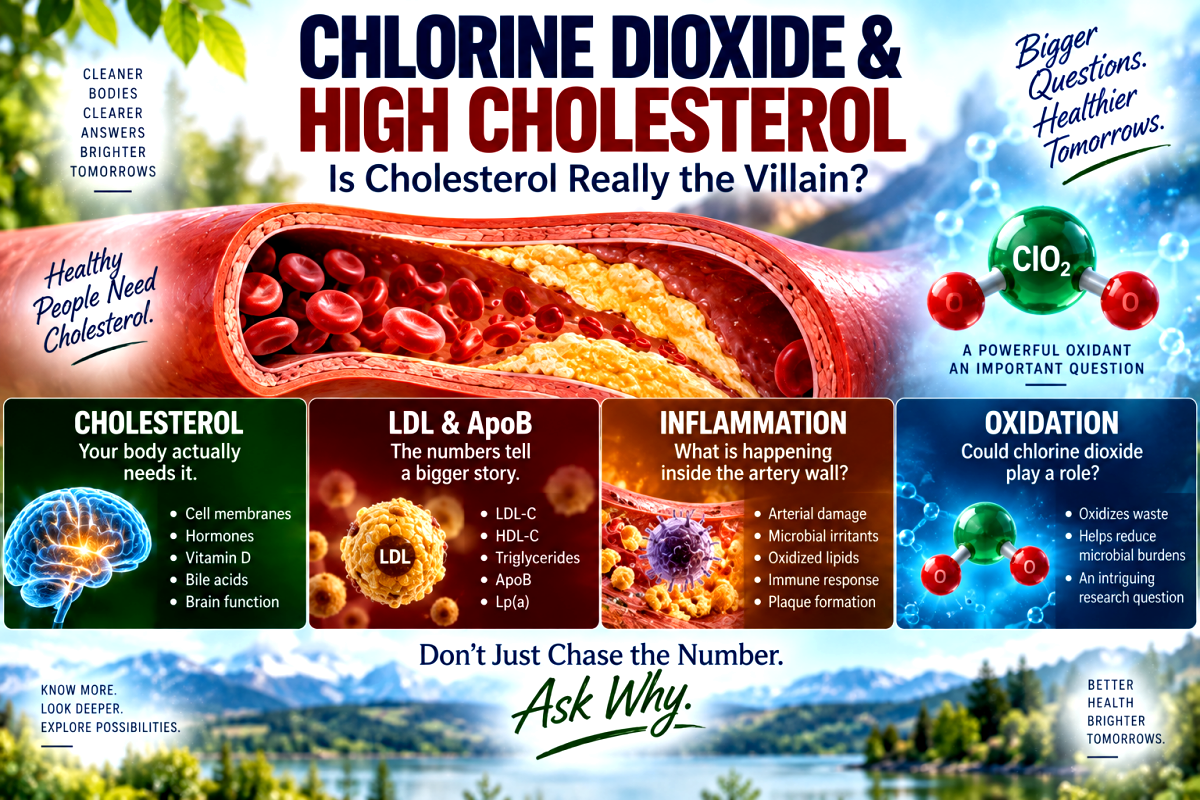
It isn’t toxic waste accidentally floating around inside you. Your body deliberately makes it. Your liver produces cholesterol, virtually every cell uses it, and without cholesterol, you wouldn’t be healthier. You wouldn’t be alive.
So when someone has high cholesterol, perhaps the most interesting question isn’t simply: “How do we get the number down?” It is also: “Why is this person’s cholesterol metabolism behaving this way?”
That question has led Herb Roi Richards, author of Chlorine Dioxide for Humans: Recipes & Treatment, to look at high cholesterol somewhat differently. And, perhaps surprisingly, to ask whether chlorine dioxide belongs somewhere in the research conversation.
First: Cholesterol Is Not the Villain
Cholesterol performs essential jobs throughout the body.
Cholesterol contributes to:
- cell membranes
- steroid hormones
- vitamin D production
- bile acids used in digestion
- normal nervous-system function
- brain structure and function
The brain is particularly cholesterol-rich. Although the often-repeated statement that the brain is “mainly made of cholesterol” goes too far, the brain contains a disproportionately large share of the body’s cholesterol.
Herb’s colorful observation contains an important underlying truth: Having even less brain cannot be an upgrade. The goal should never be to eliminate cholesterol.
The real issue is how cholesterol is transported and regulated and what is happening inside the arteries.
What Does “High Cholesterol” Actually Mean?
This is where modern understanding has become considerably more sophisticated. Cholesterol doesn’t travel freely through blood. It is transported inside particles called lipoproteins.
You’ve probably heard of two:
- LDL — commonly called “bad cholesterol.”
- HDL — commonly called “good cholesterol.”
Those nicknames are convenient, but they’re oversimplifications.
LDL carries cholesterol to tissues throughout the body. The problem develops when excessive numbers of cholesterol-containing particles—particularly ApoB-containing particles such as LDL—enter and become retained within arterial walls.
That can initiate and accelerate the process of atherosclerosis. Inflammation participates in that process too.
Herb is right to be interested in inflammation. But cholesterol isn’t merely arriving afterward with a toolbox to patch an injured pipe.
The cholesterol-carrying particles themselves can participate in the development of the plaque. That’s an important distinction.
And High Cholesterol Usually Doesn’t Have Symptoms
High cholesterol is notorious for being quiet. A person can feel terrific while cardiovascular risk gradually increases. Fatigue, brain fog, or poor circulation may occur for countless reasons, but they aren’t reliable indicators of high cholesterol. That’s why a blood test matters.
Depending on someone’s situation, useful measurements can include:
- Total cholesterol
- LDL-C
- HDL-C
- Triglycerides
and increasingly,
- ApoB
Some people also benefit from having lipoprotein(a), or Lp(a), measured. These numbers tell us considerably more than symptoms can.
Where Herb’s Theory Gets Interesting
Richards approaches the problem from another direction. His field hypothesis is that inflammation, microbial irritants, metabolic waste, environmental exposures, and other stresses can contribute to an unhealthy internal environment—and that improving that environment may help the body normalize some of its chemistry.
From that perspective, he became interested in chlorine dioxide because chlorine dioxide is an oxidizing agent with established antimicrobial activity. That’s the point where an interesting scientific question appears.
Could chlorine dioxide somehow influence the biological processes associated with cardiovascular inflammation or lipid metabolism?
We don’t presently have good clinical evidence showing that it does. But we can examine why someone might ask the question.
Chlorine Dioxide Does Something Cholesterol Does Not
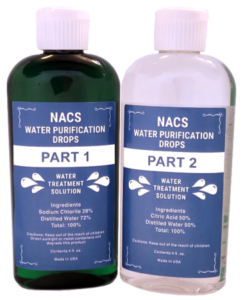
Chlorine dioxide is chemically reactive. It oxidizes particular molecules and is remarkably useful for controlling microorganisms in applications such as water treatment. Its antimicrobial action is well established outside the body. Richards’ hypothesis goes further.
He proposes that some people experiencing high cholesterol may also have microbial, inflammatory, or other biological burdens and that oxidative chemistry could reduce some of those triggers.
According to his field observations, when those underlying stresses improve, cholesterol measurements improve as well.
He summarizes his experience rather boldly: “Talk to ten people using chlorine dioxide for this, and at least eight will describe something close to this.”
That’s an observation from Richards’ experience. It isn’t an 80-percent success rate established by a clinical trial. And that difference is important. But if repeated observations are genuine, they’re also something that could be measured.
There’s an Oxidation Paradox Here
This is where the subject becomes especially interesting. If oxidation is supposed to help, wouldn’t oxidation also potentially be harmful? Yes. Oxidative modification of LDL has long been investigated as part of atherosclerosis biology.
That means we cannot simply reason: Chlorine dioxide is an oxidizer → oxidation cleans things up → therefore chlorine dioxide must improve cardiovascular health.
Biology is more complicated. The molecule being oxidized matters. The location matters. The concentration matters. The duration matters. And the body’s response matters.
This creates a much better research question:
At carefully characterized exposures, what does chlorine dioxide actually do to markers of lipid metabolism, inflammation, and vascular health in living humans?
That can be tested.
What Would a Chlorine Dioxide Cholesterol Study Look Like?
This wouldn’t actually be difficult to investigate conceptually. Start with people who have elevated cholesterol measurements.
Establish their baseline:
- LDL-C
- HDL-C
- triglycerides
- ApoB
- inflammatory markers
- blood pressure
- liver and kidney function
Researchers could then randomly assign participants to appropriately designed intervention and control groups, monitor safety carefully, and repeat the measurements at predetermined intervals.
If cholesterol numbers changed, researchers could ask another question:
- Why?
- Did LDL change?
- Did ApoB change?
- Did triglycerides change?
- Did inflammation change?
- Did liver cholesterol metabolism change?
- Was there any effect on vascular function?
- And—critically—were there adverse effects?
Suddenly, the discussion moves beyond testimonials. We have data.
What About Herb’s Three-Week Protocol?
In Chlorine Dioxide for Humans, Richards describes a repeated oral chlorine dioxide regimen for high cholesterol, followed by what he calls maintenance use. He also describes topical applications and companion products. Those recommendations represent Richards’ protocol and field experience, not a clinically established treatment for high cholesterol.
I wouldn’t turn the exact dosing instructions into a public cholesterol-treatment recipe.
Why? Because we don’t have clinical trials establishing an effective therapeutic dose for lowering cardiovascular risk. More importantly, lowering a laboratory number isn’t enough. The meaningful endpoint is whether an intervention safely reduces heart attacks, strokes, disability, or death. Those are much higher standards.
What About Coconut, Avocado, Flax, and Olive Oils?
Here’s another area where Herb’s approach becomes interesting.
Richards recommends what he calls “clean fats,” including:
- Virgin coconut oil
- avocado
- flaxseed oil
- olive oil
But these fats aren’t metabolically interchangeable.
Olive oil and avocado provide substantial monounsaturated fat. Flaxseed oil is particularly rich in alpha-linolenic acid, an omega-3 fatty acid. Coconut oil contains much more saturated fat and can raise LDL cholesterol in some people.
So rather than placing every natural fat into a single “good fat” category, it makes sense to consider what each one actually does.
“Natural” describes where something came from. It doesn’t necessarily describe its effect on LDL.
And the Companion Products?
Richards also discusses several companion products in his cholesterol approach, including:
Apple cider vinegar
Frequently used in natural-health programs involving meals and metabolic health.
Aloe vera
Used traditionally for a wide variety of wellness applications.
Flaxseed oil
A source of alpha-linolenic acid.
Lugol’s iodine
An iodine preparation that affects thyroid biology—and therefore deserves particular care because thyroid function itself can substantially affect cholesterol levels.
Bentonite clay
Used by some natural-health practitioners as part of digestive or “detox” programs.
These shouldn’t be treated as interchangeable cholesterol medicines. And iodine presents an especially useful lesson.
Sometimes High Cholesterol Is Telling You Something
Suppose someone’s LDL suddenly rises. It might be tempting to treat the number immediately. But what if the person has developed hypothyroidism?
Low thyroid function can increase LDL cholesterol. Other contributors can include:
- genetics
- insulin resistance
- diabetes
- dietary patterns
- obesity
- kidney disease
- certain medications
- menopause and aging
- familial hypercholesterolemia
This is precisely why I like the broader spirit behind Herb’s approach: Ask why. Just don’t assume beforehand what the answer will be.
“Clean the Pipes” Is a Great Metaphor
Herb summarizes his observations this way:
“Their numbers dropped when they stopped treating cholesterol like the problem and started cleaning the pipes it was patching.”
It’s memorable. And there’s wisdom in looking beyond one laboratory number toward the whole person. But arteries aren’t household plumbing.
Atherosclerotic plaque develops within the artery wall through a complicated interaction involving ApoB-containing lipoproteins, immune cells, inflammation, vascular biology, genetics, and metabolism.
You can’t simply flush plaque out. What you can do is identify and modify the biological processes driving its progression. And that brings us back to the chlorine dioxide question.
Maybe the Question Isn’t “Does Chlorine Dioxide Lower Cholesterol?”
Perhaps that’s too small a question. A more interesting investigation would ask:
- Does chlorine dioxide measurably influence lipid metabolism?
- Does it affect ApoB?
- Does it change inflammatory markers?
- Does its antimicrobial action matter in any subgroup of people with cardiovascular disease?
- Does it produce harmful oxidative effects that outweigh any potential benefit?
- Are Richards’ repeated observations reproducible under controlled conditions?
Those questions don’t require anyone to believe Herb. And they don’t require anyone to dismiss him. They require measurements.
Don’t Throw Cholesterol Out With the Bathwater
Cholesterol is essential. The brain needs it. Every cell needs it. Hormone production depends upon it. But recognizing cholesterol’s importance doesn’t mean elevated LDL or ApoB should be ignored.
Likewise, recognizing cardiovascular risk doesn’t mean every unconventional observation about cholesterol should automatically be dismissed.
Somewhere between those extremes is a much more useful position: Understand what the body is doing.
Measure it. Look for causes. Reduce known cardiovascular risks. And when an unusual intervention repeatedly appears to produce an unexpected result, investigate it properly.
Chlorine dioxide hasn’t been clinically established as a treatment for high cholesterol. But if the cholesterol changes described by Richards and others are occurring consistently, we don’t have to turn them into medical doctrine.
We can do something much more interesting.
Study them.
Educational Notice
This article discusses hypotheses and field observations described by Herb Roi Richards and is intended for informational purposes. Chlorine dioxide has not been established as a treatment for high cholesterol, atherosclerosis, or cardiovascular disease. Ingestion of chlorine dioxide products can cause adverse effects, and established cardiovascular risk factors should not be ignored or prescribed treatments discontinued because of anecdotal reports.
High cholesterol is often symptomless. Anyone concerned about cardiovascular risk can discuss appropriate testing—including LDL-C, triglycerides, and, when appropriate, ApoB and Lp(a)—with a qualified healthcare professional.